Amanita Muscaria; Herb of Immortality
2. The Indo-Europeans
Donald E. Teeter · p. 10
It is not the purpose of this chapter to go into an in depth study of the Indo-European peoples but simply to give you some background to help you understand why the religions based on the Herb of Immortality are found so widely distributed over Eurasia. The reader is encouraged to study the Indo-European peoples and history in much greater detail and depth, since for many readers with a Eurasian heritage; they are your ancient ancestors.
The term Indo-European properly describes a very large language family, which includes English, French, Latin, Greek, Gaelic, Iranian, Hindi, and Sanskrit to name but a few. Historically this language family was found from India to Ireland hence Indo-European.
All of the Indo-European languages are descended from a common ancient ancestral language now extinct called Proto-Indo-European. Since all Indo-European languages share a common ancestor and in many ways are still very similar to each other, it is the common belief of language experts that about 7000 years ago all the Indo-European speakers in the world lived in a relatively small geographic area that is believed to be north or northeast of the Black Sea.
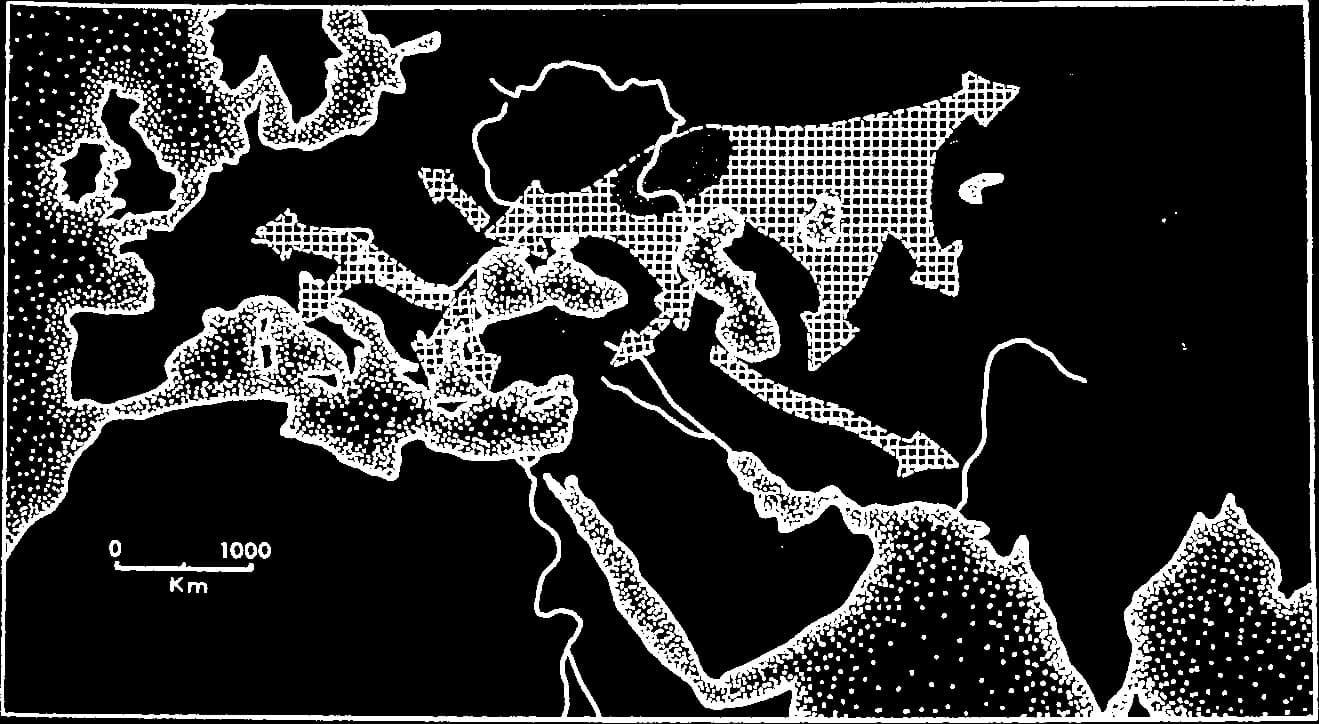
(Map: the white oval area is one of the proposed homelands while the other is just west of it N of the Black Sea, the arrows show the routes of the expansions into all the surrounding territory.)
During this time it is believed that the Proto-Indo-Europeans were the first people to domesticate the Horse for riding. There is also archaeological evidence that these people began an extensive development and use of the wheel for carts and wagons, this technology of greatly increased mobility is believed to have been part of the reason for the Indo-European expansion.
Beginning about 6000 years ago there is an expansion of Indo-European speakers out of this homeland East into the Steppes of central Asia and West into central Europe.
Approximately 5000 years ago there is another expansion into Mesopotamia, Persia, Europe and eastward deeper into the Steppes.
About 4000 years ago there is a major expansion from which most of the modern Indo-European languages are descended; this expansion extends the Indo-European languages over a vast area of Europe, the Middle East, central Asia, Northern India, and the Siberian Steppe to Manchuria.
Less than 1400 years ago the rise of Islam spread the non Indo-European Arabic language over much of the formerly Greek and Persian speaking areas of the Middle East and North Africa.
Beginning about 900 years ago the movement of Mongol and Turkish tribes greatly reduces the number of Indo-European speaking tribes on the steppes through warfare, genocide and assimilation, and eventually splits the Indo-European language continuum by the invasion of what is now called Turkey, where the Turkish language replaced Greek.
Within the last 500 yrs with the Age of Discovery there is an expansion of Indo-European speakers into the Asian Steppes, Siberia, North and South America, India and East Asia, Australia and Africa.
About 200 years ago European explorers bring back to Europe ancient writings from India such as the Rig Veda, and the Yasna from Persia, both of which were unknown in Europe at the time.
Language scholars quickly discovered that Sanskrit and ancient Persian were closely related to Latin and Greek and the study of the Indo-European language family was born.
Presently, one half of the world’s population speaks an Indo-European language as a first or second language.