Amanita Muscaria; Herb of Immortality
9. Natural Science
Donald E. Teeter · p. 33
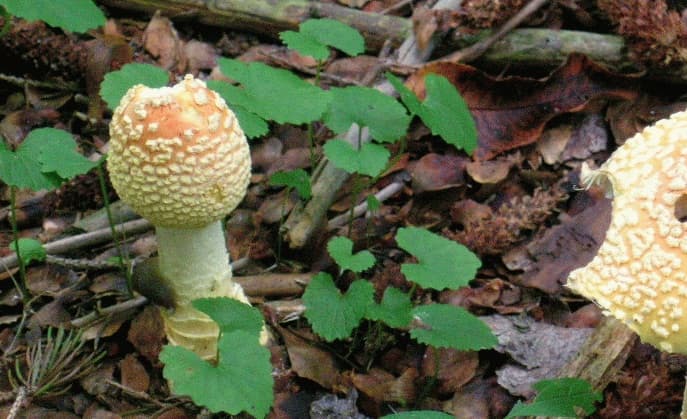
Amanita Muscaria, common name Fly Agaric
.
Cap; from 1-1/2 to 8 inches diameter, sometimes much larger (12 inches).
Cap Color; ranges from straw yellow, yellow orange, orange, orange red, to bright blood red.
Cap colored surface; smooth with white or off white warts on it.
Margin of Cap; may have striated surface that matches the gills below it, especially older specimens.
Gills; crowded, white, broad and free from stem with extremely fine hairy edges. μ
Spores; 8-11 × 6-8 , ellipsoid, thin walled.
Spore Print; is white.
Stalk; 1-1/2 to 10 inches long, cylindrical, pure white to off white.
Stalk Interior; pithy inside when young, older ones are hollow.
Stalk Veil; full and skirt shaped, white, persistent, sometimes has an edge of velvety yellow.
Base; bulbous, covered in scale like patches of vulva in concentric rings.
Flesh; is white to off white, firm.
Season; in most of N. America; June to fall frost, in certain areas like coastal California and Florida it fruits in Dec. Jan, in other areas it is a spring mushroom.
Habitat; found only in association with certain tree species, pine, spruce, larch, fir, hemlock, birch, beech, maple, hazel, olive, and, rarely, oak.
Distribution; world wide, wherever suitable forest habitat and soil conditions are found.
I sincerely hope that anyone considering gathering this mushroom will buy a good field guide. I have looked at many; the best field guide I have found to date is the Audubon Society Field Guide to North American Mushrooms; the real photos are a great help. There are several other species of mushroom that may confuse an amateur, some have unknown toxicity, some are edible but they are not the herb of Life. A good field guide will help in determining exactly what you are looking at.
All mushroom literature will state that Amanita Muscaria is poisonous! Fresh mushrooms are somewhat toxic, proper drying, however, radically changes the mushroom’s chemistry. Some literature also lists this plant as a hallucinogen, without mentioning the fact that it has to be dried to be psychoactive, that’s irresponsible, being an advertisement to misadventure. Other literature mentions the Siberian use as a hallucinogen, and then maintains that the Siberian Amanita Muscaria is different from the North American Amanita Muscaria. This is not the difference, drying is the difference! The Siberians thoroughly dry theirs before consumption, while Westerners are making themselves sick on raw ones!
The spores of this Fungus are small enough to ride the wind to anywhere on the planet! Siberian spores are landing in North America while North American spores are landing in Siberia.
There may be local variations in areas but this species is breeding planet wide and some of the variation may just be differences in growing conditions: New York to New England and coastal California being home to a golden yellow variety with the occasional orange or bright red one appearing; the west coast range and Rocky mountains produce a blood red variety with the occasional orange or yellow showing up, orange is found over most of the remaining country with the occasional yellow or red ones. From yellow to orange to red, they all seem to have the same effect and identical taste, if dried identically. In comparing independent chemical analysis of Amanita Muscaria specimens from Italy, Holland, South Africa, Japan, North America and Siberia no significant differences were found in this fungi’s chemistry.
It is interesting to note that the red, orange, and yellow specimens are sometimes indistinguishable from each other when dried, turning to a dull gold color on the cap. Some literature states that there are several different color varieties of Amanita Muscaria, each having its own variety name: as in A. Muscaria var. Muscaria, red fly Agaric; A. Muscaria var. Formosa, the yellow orange fly Agaric. The Fly Agaric even has a white variety. The experts are not done thrashing all this out yet. I, however, only gather the yellow, orange, or red ones.
Host trees seem to make a slight difference in potency; in my personal experience the ones growing with any species of pine being slightly better than other host tree species. In your area it may be a different tree host that yields the best herb of Life. The Amanita Muscaria is a mycorhiza fungus and it lives in a symbiotic relationship with certain tree species. The body of the fungus actually coats the tree’s roots. It supplies the tree with water, nutrients and antibiotics; in return the fungus receives food.
Living Amanita Muscaria is often found with paralyzed insects and slugs that tried to eat the mushroom. If you remove the comatose victim it regains its senses in about 20 minutes. The fungus sheathing of tree roots probably protects against insect and nematode attack. The fungus could, in fact, be a predator of small life forms, paralyzing its victims and then absorbing them, this small prey being a ready source of nitrogen and other nutrients needed by the fungus and its host tree.
The common name Fly Agaric is based on the folk belief that it kills flies. I have not found that to be true; they simply become comatose if they are exposed to fresh fly Agaric. Dried fly Agaric in milk is very attractive to flies; they are irresistibly drawn to it, becoming hilariously intoxicated after consuming it. The flies recover in 12 to 24 hours, seemingly none the worse for the experience.