Amanita Muscaria; Herb of Immortality
11. Natural Magic
Donald E. Teeter · p. 37
The following material details how to find and prepare Amanita Muscaria for use as a sacrament.
It is up to the reader to exercise caution and restraint when first trying the Amanita Muscaria mushroom; individuals vary widely in their response to various substances. It is much better to have a lighter pleasant effect than to be overpowered. While I personally have never seen anyone experience a bad effect, there is always that possibility.
Our ancient fathers called it the herb of Life; let’s keep it that way. The Amanita Muscaria is Sacred; treat it and yourself with respect. To find and consume the Amanita Muscaria mushroom is to embark on a spiritual quest.
This knowledge is given so you may have the power of choice. If you wish to use the herb for healing, you can, if you wish to explore the Sacred, its here. The herb of Life is your birthright! No man, or assembly of men, has the right to deny you contact with the divine.
The Hunt
Finding the herb of Life is a sacred hunt, the Amanita Muscaria mushroom, as mentioned in Natural Science, is a Mycorhiza mushroom. It lives in a symbiotic relationship with various species of trees such as Pine, Spruce, Larch, Birch, Beech, Maple, Hemlock, Fir, Hazel, Olive, and occasionally, the Oaks. So, I don’t hunt the herb as much as the trees that support it. The Amanita Muscaria mushrooms will always be found in association with these trees, in the area encompassed by the tree roots. The herb also needs drainage; sandy soil or sloping terrain seems to be preferred.
Over most of North America the fungus fruits from June to November. In California and Florida it fruits in some areas in the winter, the only sure way to discover where the herb is to spend as much time on the hunting as you can afford during its season.
Once you have found the Amanita Muscaria mushrooms in a certain place, returning there to check from season to season is usually a good idea. Eventually you will compile a list of areas where you know the herb lives. It then becomes a matter of catching the fruiting. Do not be greedy, this plant is essential to the life of the forest; I always leave the older worm eaten and the very young buttons. The old ones don’t taste good but are still releasing spores while the very young buttons could easily be confused with a button of a different fungus. If all you find are young buttons; try to return in a day or two; they should be in their prime by then.
A prime specimen has a basically flat cap and is about its full size. It should be fresh looking and undamaged by insects, slugs or weathering. Rounded caps mean it is 1 to 3 days from maturity. Upturned edges on a cap mean it’s an older specimen; as long as they look fresh all three levels of maturity can be harvested.
A few simple items make harvesting easier. A basket to carry them in, lined with a clean cloth, a couple of small clean soft brushes to remove debris from the specimens and a flat blade screwdriver or an old stiff kitchen knife. Just slide the screwdriver or knife into the ground next to the specimen’s stem and pry up, it should just pop up whole.
It is a lot easier removing dirt and debris from the specimen before it starts to dry and the less dirt in the specimen basket the better, so I try to clean them thoroughly as I am harvesting with brushes and my fingers. Removing the stem from the cap at this time seems to result in less over all damage, as does segregating the caps from the stems in the basket since the caps are somewhat fragile.
Amanita Muscaria should be dried as soon as possible after harvest. Final cleaning of the herb should be done before drying. Sometimes a thin layer of soil is actually trapped in the skin of the stem’s butt. Gently scraping with a knife will remove it; a final cleaning can be done in this area after drying.
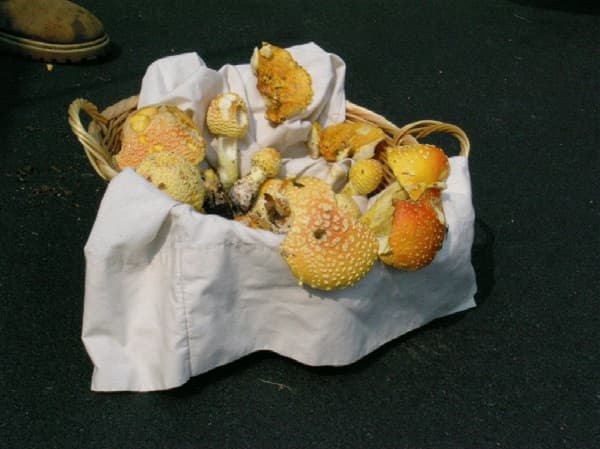
A basket of Amanita Muscaria mushrooms.
Preparing the Plant of Life
Once fresh specimens are obtained they must be dried before use! I remove the cap from the stem (if not already done) and slice the stem into quarters lengthwise the cap will dry whole. Placed on a screen or rack with good air movement they should dry in a day or two. If placed over a heating vent or oven dried, do not exceed 120 deg. F. A conventional food dehydrator with a temperature control works very well. Dry the Amanita Muscaria mushrooms until completely dry; it should be cracker dry, pieces should snap when bent. Once dry it should be placed in sealable plastic bags, sealing the dried herb of Life in the bags creates the most delectable fragrance, it’s no wonder the ancient Aryans also called it “Andhas” R.V. literally “the flower.” These bags can then be stored in glass or plastic containers; store in a dry cool dark area.
These dried Amanita Muscaria mushrooms should be aged for 2 or 3 months before using to allow a good curing of the specimens. Proper drying and curing is essential for both good taste and potency. The bread of Heaven can be simply eaten as is or used in the following preparati ons.
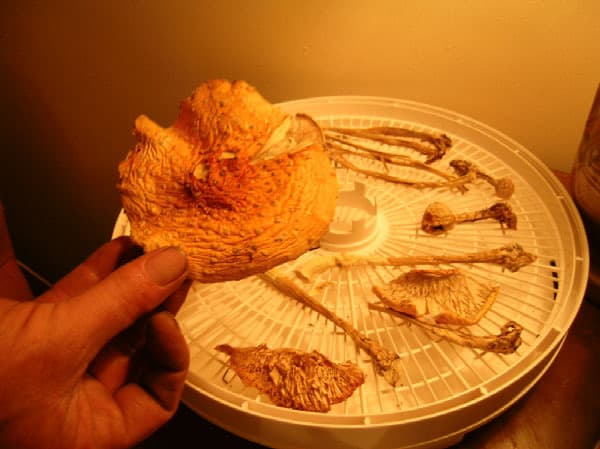
Dried Amanita Muscaria pieces being removed from the drier.
WARNING: Do not consume any carbonated beverage, (beer, soda, etc.) before or after consuming the dried Amanita Muscaria. It appears that Muscimol can be reconverted into Ibotenic Acid in the presence of carbonated water. This reverses the effects of drying where Ibotenic Acid loses CO and becomes Muscimol. The
2
resulting effect being similar to fresh Amanita Muscaria ingestion nausea, vomiting, stomach cramps, stupor, coma like sleep, excess salivation and no hallucinogenic effect!
Magic Food
In Soma: Divine mushroom of Immortality it is mentioned that the Siberian tribes using Amanita Muscaria often placed the dried mushroom into soups and stews thus creating magic food and this is one of the most enjoyable ways of consuming Amanita Muscaria. Crushed or powdered dried Amanita can easily be added to a bowl of stew, soup or oatmeal and actually makes the food taste better. This is probably the best way to begin using the Herb of Life.
Ambrosia; elixir of Life
It’s easy to turn water to wine if you have the properly dried specimens. Simply weigh out the desired amount of dried Amanita Muscaria pieces. Place cap pieces upside down in the bottom of a small Mason type jar. Break stem pieces into ½” to 1” lengths and place on cap pieces. Shake gently to settle pieces into the smallest volume. Add just enough cool drinking water to cover the herb and let soak for at least 3 hours at room temperature. The water should be a dark amber color.
Pour off the ambrosia into a second glass or jar (using a strainer), cover the second jar and set aside. Add the same amount of new drinking water to the Amanita Muscaria pieces in the first jar, let sit for at least 2 hours. This water should become almost as colored as the first run. Strain liquid as before, into the second jar, which already holds the first run. A third run may be taken if you wish but it will be considerably weaker than the first two extractions. I usually press the pieces with a fork to squeeze out more ambrosia, and then rinse the pieces and the first jar with a small amount of water, strain and add to the second jar.
This procedure yields ambrosia that is both tasty and potent. The original pieces being left somewhat larger for a reason, the mushroom is in fact a pump. When rehydrated with water it goes back to pumping water through its body, leading to a fairly efficient water extraction of the water-soluble chemicals.
It takes slightly more dried Amanita Muscaria per dose, when making ambrosia than just consuming the dried mushroom, but the resulting experience seems clearer and cleaner with the ambrosia, with only the most water-soluble chemicals and sugars being in the ambrosia. This concentrated ambrosia is sweet to the taste. The flavor of well-made ambrosia is unique, tasting to me like a weak honey, malt and water solution. Just like coffee, tea or beer making, the quality of the water used has an effect on the taste. Reverse osmosis or distilled water yielding the best flavor.
The similarity between the word ambrosia and amber, probably relate to the color of the ambrosia, which is always a shade of amber. Ambrosia being yellow amber in transmitted light and reddish amber in reflected light.
The ambrosia is best when sipped slowly and allowed to lie on your tongue for a few seconds before swallowing.
Sacred Wine
A variation of the standard Ambrosia is to substitute Grape juice for the water. You can make this Sacred wine very easily by using approximately one oz. (28 grams) of dried Amanita Muscaria per quart of grape juice, soak for 8 - 12 hrs then strain off the juice and press the mushroom pieces to recover more juice, which is added back to the strained juice. It seems to me that a slightly acidic Grape juice works best and a few drops of vinegar added per cup of juice at the start seems to make it more potent.
This wine has the unique property of getting more potent (up to a point) from being diluted with water! For best results you should dilute this wine using 2 – 4 cups water for every cup of wine before drinking. When properly diluted with water it will slack your thirst, if it is not diluted enough it will dry your mouth in a few minutes.
Preparing the Seer’s Milk
The mixing of milk with the herb or the expressed juice is a very ancient practice dating back at least 4000 years; and, reports from Siberia dating from the 1900s report the fermenting of dried Amanita Muscaria with reindeer milk. In the Rig Veda, the expressed juice is mixed with soured milk and curds before being consumed, no time seems to have been allowed for fermentation. The lactic acid present in the soured milk probably reacts quickly with the Muscimol, converting it to a more potent form.
Personally, I can’t drink sour milk so I use a different method. I place small pieces of the herb into a bowl or jar and add whole homogenized fresh milk: ¾ - 1-cup milk per one average sized (5-7 grams) shredded dried specimen. Place in a cool room (60-70 deg. F.); cover the bowl with a clean cloth or paper towel.
If there are any flies in the room, they will show you when it’s ready, they will be drawn to it like iron to a magnet. If a drop is placed on a plate, when the flies find it they will become intoxicated. Just the smell of it seems both irresistible and intoxicating to them. This property explains the ancient Biblical name Beelzebub the Lord of the Flies.
If there are no flies around, pull a drop out every hour (with an eyedropper) and taste. At 60 deg. F. it may take 12 hours or more to ferment. The milk will not readily spoil and still tastes sweet after 24 hours. At about 30 hours it turns to a non-psychoactive yogurt that then spoils. The fact the milk doesn’t readily spoil shows the antibiotic properties of Amanita Muscaria.
Properly fermented milk is much stronger than the herb or ambrosia. You will know when it is ready with the one-drop taste test. When you are sure it’s reached its peak, strain the milk into a glass or cup. Press the pieces in the bowl with a spoon or fork to try and recover as much milk as you can; sip very slowly and enjoy.
Preparing the Holy Oil
Olive oil and animal fat are both absorbed into the skin. As far as preservability goes, olive oil has an edge over animal fat, especially in warm or hot conditions.
The active principal of the herb can also be absorbed into the skin; if you gently hold a fresh Amanita Muscaria stem in your hand for about 5 minutes, you will start feeling a light giddiness, the longer the contact, the more intense the effects.
To create the holy oil, powder some dried specimens and sift the powder through a fine cloth. Return the pieces that didn’t pass to being repowdered. Once you have the desired amount of fine herb powder, place into a clean dry small sealable vial or bottle. Slowly add just enough olive oil to cover the powder. Using a piece of wire, gently stir the powder and olive oil together. Add more oil as needed to create a thin paste. Seal the container and let the herb soak in the oil for an hour or two. To use, place a fingertip on the surface of the oil and apply to the center of the forehead about an inch or so above the eyebrows. The effects should start in a few minutes and last until the oil is all absorbed. This is the most controllable method of using dried Amanita Muscaria and probably the most efficient way of using a limited quantity of dried mushroom for a number of people. The effects are never too intense unless too much oil was applied.
This oil is also a very effective topical antibiotic and can be used on many different infections of the skin; such as inflamed insect bites or other infected wounds.
Preparing the Living Water
If you eat the dried herb of Life, drink the ambrosia or consume the milk of prophecy, you will produce the Living Water. The dosage going in determines the strength of what comes out. Approximately 7/8 of the active principal is excreted in the urine. The rest is probably sweated out. Recycling the active principal is a way to greatly extend the duration of the experience with a given amount of herb.
Many people will be disgusted at the thought of drinking their own urine. Fresh urine is, however, more sterile than tap water if you do not have a kidney infection. Urine spoils very quickly when exposed to microbes from the air; they multiply rapidly in the nutrient rich solution. The presence of the herb’s essence in the urine does slow down such spoilage, another sign of antibiotic action. Personally, I have never tasted the Living Water; you are on your own with this one.
Preparing the Eucharist
The modern sacrament used by the older Christian churches is obviously descended from something; the wafer is now reputed to be composed of wheat flour. But what was it originally? If you believe the herb of Life is the Christ, then the herb as the Bread of Life would be the source of the sacramental flour.
Amanita Muscaria, when crispy dry, powders or grates easily. A mortar and pestle works well today just as it would have anciently, it’s just slow, and a small coffee grinder easily disintegrates it. Herb flour is made by sifting the ground powder through a fine cloth or screen to remove the larger pieces. These larger pieces are then reground and resifted. This is exactly the same technique used in the production of fine grade cereal flour. Eventually, you get most of the dried mushroom to sift through as herb flour. Gram for gram, herb flour is the strongest preparation that is easy to make.
This flour has many advantages for sharing among a number of people. First, the averaging effect of using multiple plants, second, in setting an accurate dose for each wafer from a batch of flour. When pressed into wafers it is easy to handle; placed on the tongue, the wafer dissolves quickly and is totally absorbed, the wafer also dissolves easily in wine, grape juice or water.
Creating the wafers is more involved than some of the other processes and will require the construction of some simple equipment. You will need a sifter and a press. The best sifter is created with two wide mouth Mason type jar ring lids. Place top-to-top, line up and tape around the outside of both with duct tape. You now have a top with two threaded ends on it and a hole in the middle. A piece of fine cloth is placed over a Mason type jar containing the course herb powder. The double lid is screwed down over the cloth onto the jar. A clean, dry, empty jar is now screwed onto the other side of the top. To sift, you place “course powder” jar up and shake. The fine powder will collect in the empty jar that is now on the bottom. The advantage of this sifter is that you don’t lose much fine dust.
The cloth should be sheer and fine in weave. The threads should be smooth, not fuzzy. The ideal fabric looks like a fine screen when held up to the light. The cloth must be perfectly dry or it won’t sift.
The ancient style of sifter can be easily recreated with an embroidery hoop and a piece of cloth. Sift into a large shallow bowl. A gentle motion is all that’s needed. The advantage of this sifter is that it can be much larger in the cloth area than a wide mouth jar lid. It sifts faster but must be used in a draft free area, and you are going to lose some fine dust.
For the herb flour to be turned into a wafer, you need a press. In the Sacred Secret I gave instructions on how to build a simple but crude press. Then I discovered that presses could be purchased from Church supply houses that are specifically made to produce the Eucharist wafer; these presses can do a superior job than the home built one.
It may take some experience and trial and error to tune the operation. The wafers should be pressed hard enough to withstand some handling and still dissolve on the tongue or in liquid.
Using a set of measuring spoons, determine the amount of herb flour to be used for each wafer. Then, use the spoon chosen to set the volume for every wafer produced from that particular batch of flour. This achieves uniformity from wafer to wafer, especially if the spoon is over filled and then struck off level with a knife.
When not being used, the die pieces should be stored in a clean dry area. Anything that touches the herb flour should be dry!
As you can see, the technology needed to create the wafer type herb sacrament was easily in reach of the early Christians. Everything involved was already in use in ancient Middle Eastern herbal practices. The early Christians had good pharmacological reasons for developing and using the herb flour wafer as a sacrament. The use of this technique stretches the supplies of the herb to its maximum by obtaining maximum effect from minimal amounts. There are other reasons why this form of sacrament was adopted. One, people who would never eat a toadstool would have no problem eating it as a wafer. By concealing the true identity of the sacrament from both followers and enemies, the priesthood maintained control and power over the one and denied their enemies information. The sacrament could easily be substituted with cereal flour if the supplies of the herb ran out, or, if they thought the authorities were going to raid.
Like all other herb of Life preparations, grind no more flour than will be immediately used.
Honey Drops
Once you have mastered the technique of producing herb flour, you may wish to make honey drops instead of wafers. There is no need for a press. Simply produce the desired weight of flour, and then slowly and carefully fold in a small amount of pure honey. Work into a thick putty consistency. Roll into ball’s ¾” to 1” diameter or flatten out into a wafer.
The addition of honey makes a very tasty candy. The honey also seems to improve the absorption of the herb’s essence. Like all other herb of Life preparations, it should be made and used immediately.
Set and setting
When Amanita Muscaria is used Sacramentally, the set and setting are very important. The experience evoked by any psychoactive drug is affected by the set and setting where the drug is taken. The set means the individual’s expectations of the coming experience, the setting, is the physical environment where the experience is taking place.
This herb will probably not be popular as a party drug. The increased sensitivity to light and sound can be too much for a party scene. Daylight use is probably not a good idea either as a sunny day can actually be painful. Some of the shamans of Siberia, who use the herb, practice their magic in complete darkness. Early Christians also seemed to favor dark rooms or areas, catacombs, etc. (See Matthew 10:27). The auditory effects are best heard in a quiet environment; and of course, distractions should be kept to a minimum.
No one should consume more than 3.5 gr. (1/8 oz.) of the herb of Life while alone. Higher doses may produce a disassociate effect, leading to a short-lived but complete break with reality. Many people will also lose their equilibrium and stagger and fall. Both of these effects may result in physical damage from falling or other accidents. There should always be a watcher (an unintoxicated person) to guard against these events. And, of course, only an idiot would drive a vehicle while under the influence of the herb of Life!
Do not mix the dried Amanita Muscaria with other Drugs, Prescription, over the counter, or illegal.
WARNING: Do not consume any carbonated beverage (beer, soda, etc) before or after consuming the dried herb of Life. It appears that Muscimol can be reconverted into Ibotenic Acid in the presence of carbonated water. This reverses the effects of drying where Ibotenic Acid loses CO2 and becomes Muscimol. The resulting effect being similar to fresh Amanita Muscaria ingestion, with nausea, vomiting, stomach cramps, stupor, coma like sleep, excess salivation and little or no hallucinogenic effect.