Amanita Muscaria; Herb of Immortality
12. The Resurrection Question
Donald E. Teeter · p. 45
It occurred to me late in the construction of this book (The Sacred Secret) that I had not addressed a fundamental belief of Christianity, i.e. the idea of the resurrection of the Christ.
In order for my theory to hold up, the herb of Life (Amanita Muscaria) must be able to resurrect. At first, I believed the ability of the dried specimen to absorb water, rehydrate and continue to release spores; an ability mycologist refer to as resurrection was the answer. But this rehydration would happen before the plant was ritually killed (pressed and extracted). A true resurrection of the plant would have to happen after it had been so killed.
After re-reading the New Testament statements, the idea that I was reading a recipe or formula encoded in myth took hold. The constant reference to three days seemed to be an essential part of the formula. Since the rehydration with water can take place in minutes to hours, it again did not fit the three-day references.
Returning to the Rig-Veda, for more information, I discovered that the water used for rehydration had grain (barley) boiled in it, before being used on the Somas. This would result in a very nutritious food source for the fungus. A puzzling statement was also found, referring to “these ancient Somas and these new ones.” The new Somas were obviously ones picked and dried. But what could these ancient Somas be?
In Wasson’s Soma, the Siberian tribes, using Amanita Muscaria as an intoxicant, preferred older specimens that had dried in the ground; a fuzzy feel to the stem and a dark color distinguished these mushrooms. During the summer of 2000, while gathering specimens, I came upon several old specimens that had turned black. Each one was covered in a silvery gray long hairy mycelium; some of these hairy strands were more than 6 inches long. Closer inspection of these older black specimens with a hand lens revealed that the fuzz was erupting from the body of the mushroom and growing back into the ground; everywhere this fuzz touched the forest floor it had eaten the needles and leaf litter creating a bird nest like depression in the forest floor. Now was this fuzz the actual Amanita Muscaria plant; after all, the specimen is just the fruiting body? I had seen this hairy mold many times before; it appeared on specimens that had been water extracted then left in the jar for a couple of days. Had I, in fact, been resurrecting the herb of Life without knowing it?
Like everything else dealing directly with the herb of Life in this book, it was time to experiment; time to see if the Amanita Muscaria lived up to its ancient name Ambrose “not mortal.”
Dried specimens were extracted with grape juice, barley water or honey water. In all cases, the pieces left after the extraction, erupted in silvery, bluish Grey mycelium within three days at a normal room temperature. These were allowed to grow for up to three weeks after extraction. They were then dried and re-extracted. In all cases, the liquid extract was again psychoactive. This cycle was repeated three times with no real change in psychoactivity; it appears that, as long as the herb of Life is adequately fed, the cycle can be repeated indefinitely!
One must ask oneself, how could this plant get a reputation and several names based on it being immortal unless the ancients knew of it’s resurrect ability? How else can this extremely ancient belief be explained? (Ambrose = Not Mortal, Nek-Tar = Death Overcomer, Born Immortal, etc, etc.)
Always in this study, I have tried to maintain scientific and common sense principals in this search for knowledge. It should come as no surprise then, that scientific study could recover a lost science, and this is exactly what we are dealing with here. It is an ancient science of spirituality, not religion as we moderns conceive of religion.
The New Testament is ancient scientific (empirical) knowledge embedded in a story. Some ancient people were keen observers, even if their observations are explained in words and concepts foreign to our thinking. This in no way invalidates their observations or their conclusions.
There are only two ways to preserve complex knowledge without writing, both methods known to students cramming for a test.
First, make it poetry or song where the rhyme helps remember the information, the Rig Veda is a prime example of this, where the poetry of the Hymns lends itself to being used as such a vehicle of knowledge.
Second, make it part of a story. In remembering the story, the knowledge is remembered, but the story itself must be memorable. The New Testament is an example of this second method. As long as you know this story actually contains hidden knowledge, there is no misunderstanding; but if you don’t know it is really a vehicle for transmitting hidden knowledge; and so believe it to be literal, then misunderstanding is all this method can produce.
All the major points in the New Testament such as “the virgin birth,” “water to wine”, “healing,” “prophecy” and “the resurrection” fit Amanita Muscaria precisely. They do not fit a man or any other life form on the planet.
The rediscovery of this plant’s resurrect ability is the last piece of the puzzle. It is the last major point in this Mushroom’s identification as the Christ in the gospels of the New Testament. This mushroom resurrects so simply and naturally, any aware human, liquid extracting the mushrooms rather than just eating it could discover it quite easily.
Could any plant be more magical in the eyes of ancient people? Consuming an extract of a hallucinogenic plant, that will not die, would be the ultimate act of magic for the ancients. Nothing else could even come close to the power of this act. The fact that this Fungus exhibits antibiotic action would only reinforce this belief, all the more so if it actually extends a human’s life span!
We have now come to the very foundation of religious belief in the west, this being human immortality. “We have drunk the Soma, we have become immortal” claim the Seers in the Rig Veda. Of course, they have become immortal, for they have drunk the immortal Soma. Can the New Testament’s claims of consuming the Christ and immortality be understood any other way? No, it can only make sense in this context, that if you consume the immortal, you become immortal. This is pure magical thinking, exactly the kind of thinking you would expect to find at the very dawn of religion.
All religions are descended from shamanism; and a shaman’s job is to make contact with the divine; could there be any more divine life form available to make that contact with than this immortal plant?
This wonderful herb proclaims its own divinity. In overcoming its own death, it demonstrates its power. In brilliant visions it shows its divinity. In fantastic sayings or celestial songs, it teaches with moral force. In pulling back the curtain of time and revealing the future, it shows itself as a god. In driving illness from sick bodies, it reveals divine healing powers. In its joy, the heart is gladdened. This was a divinity a man could know. A god, meant to be worshipped by being killed and used, but no wrong done. You have slain a god yet he lives again! An awesome god who lies down its life, for those who love him, and takes it up once more, a god that tastes death, yet is deathless itself, a completely guilt free gift, straight from the creator of all things.
Now, let’s leave what the ancients thought of this herb of immortality, and return to the experiments and what this herb can teach us today.
An extraction with food source liquids in an effort to produce an extra pleasant drink, would invariably lead to resurrection. Like all fungi, the herb is temperature sensitive and prefers warmth to resurrect in the mentioned 3 days.
Amanita Muscaria must be a very effective antibiotic producer. All experiments were carried out in a non-sterile environment, in an effort to replicate the ancient conditions. So these experiments must have been subject to spores and bacteria in massive amounts. Yet not one appeared to be contaminated with any other life form. I have even carried out the whole process, from extraction with grape juice to resurrection, to its greatest growth, outdoors during the late summer, with only a cloth covering the jar’s mouth to keep bugs out. Not only could the ancients have carried out the resurrection, I believe, anyone can! This simple experiment should be proof to anyone that Amanita Muscaria is producing one or more exceptional antibiotics.
All the resurrected cultures were dried to convert Ibotenic Acid to Muscimol, these seemed to possess the same gram for gram potency that they originally had.
The foods used were grape juice, boiled barley water and honey water. Grape juice was chosen because it was readily available to ancient people in the Middle East and Mediterranean Basin.
Barley cooked in an excess of water, the water strained off and then used, was chosen because of it being mentioned in the Rig Veda. Barley was also one of the earliest cereal grains to be cultivated, so, it would be available very early in history.
Honey was available to humans long before agriculture. Honey is the most widely available sweetener in Eurasia. It would, of course, have been used to sweeten any beverage. The honey was diluted in water to create a slightly sweet tasting solution before being used.
When the cultures resurrect, and while growing, the appearance is one of mold. An aggressive, hairy, bluish gray to white mycelium completely covers the pieces of specimens. It looks like it should smell very bad; however, this is not the case! Resurrected with grape juice, there is a slight vinegar smell that transforms into one of the most delightful flowery fragrances I have ever smelled. Barley water produces a much heavier smell that while strong, is not offensive. Resurrected with honey, the smell is flowery, mild and pleasant. This is important to show that the resurrected Amanita Muscaria would not offend man. There is no reason a person, acquainted with the herb, would not try the resurrected specimen in an extraction.
It is obvious that the food sources I chose are also the food source liquids used for another fungus cultivation, yeast, yielding wine, beer and mead. All three were known from ancient to modern times. But in light of the new knowledge of the herb of Life’s resurrection, can we be sure that all ancient wines etc. were really alcoholic? A comparison of modern wine, ancient wine and a grape juice, Amanita Muscaria extract is in the Question of Wine in the following chapter.
Observations on the Resurrection of Amanita Muscaria
This Fungus needs oxygen, sealing it in an airtight jar; results in slow or no growth, with the production of very smelly chemicals. All the experiments were covered with a cloth or paper towel. This seemed to supply enough oxygen and keep the humidity levels high enough.
In the dark, the mycelium is actually a pure snow white; this quickly changes on exposure to light, to a silvery, bluish gray color. Occasionally there is a brownish tint. The pieces of the original specimen invariably turn dark, from a dark brown to almost black; they also grow back together into one piece. After this mycelium has been observed a few times it is easy to recognize, it is very distinctive in appearance and the color change from light is another identifying mark.
This plant likes warmth, with 60 deg. F. to 80 deg. F. being suitable for growth. Resurrection in three days requires 65- 70 deg. F. After the mycelium starts to grow it will continue until it runs out of food and or water; this can take several weeks, I just let them grow till they stop. Do not shake or handle too rough while it’s growing and don’t place the jar in direct sunlight, it can be burned.
Amanita Muscaria is a very hardy life form; I have resurrected dry specimens that were powdered before extraction, plus, those actually crushed, while full of grape juice, these were reduced to slime, and still resurrected! Although in both instances, it took slightly longer to resurrect these abused ones.
Once resurrected, the dried fungus returns to a living state much quicker than it does in the case of the specimen. Subsequent resurrections easily happen within three days. In order to prevent the extract from becoming charged with living chemicals, I only extract dried resurrections for half the time of specimens. (12 hours max!)
Drying the resurrections is necessary to convert Ibotenic Acid to Muscimol. Dry the same as a specimen. It can also be dried in the jar or bottle it grew in. Simply remove paper or cloth cover and place jar in a warm oven 120 deg. F. until dry. This reduces the handling damage to the mycelium considerably.
I believe that the natural ability of Amanita Muscaria to resurrect allows it to; one, take advantage of food on the surface of the forest and two, be consumed by animals and distributed over a wide area.
Since almost any organic matter on the surface such as leaves etc is capable of being consumed by Amanita Muscaria the Mushrooms ability to actually reach out with its mycelium and eat its above ground surroundings under certain weather conditions must give it a certain advantage.
Amanita Muscaria mushrooms are routinely consumed by a large number of animal species such as slugs, squirrels and other rodents, opossum, raccoon, deer and the occasional human. When the mushroom is digested and then passed as feces the spores germinate and the mycelium will use the feces as a concentrated source of food. When Amanita Muscaria is fruiting it is not uncommon to find fresh deer feces with what certainly appears to be Amanita Muscaria mycelium sprouting several inches long. Since animals can move a considerable distance and the Amanita Muscaria mushroom spores are getting a concentrated food source as a head start this ability has considerable survival value. In this the mushroom is acting just like most fruiting plants, which give animals food in return for their dispersing the plant’s seeds over a wide area.
In these instances the Amanita Muscaria mycelium that is exposed to the environment develops spores similar to those produced by the simpler fungi. Under the microscope there are small balls along the length of the exposed mycelium, which turn black when mature. Each of these tiny balls containing several hundred clear spores, and there can be thousands of these balls in even a tiny Amanita Muscaria culture.
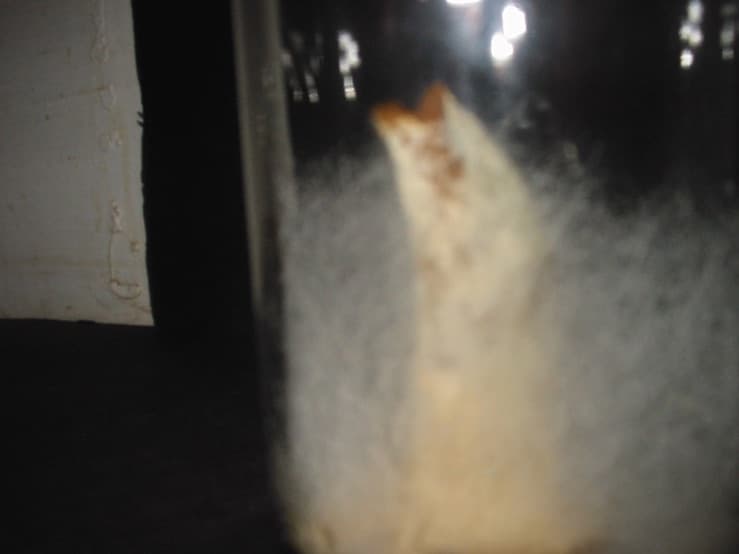
A single stem of dried Amanita Muscaria on the third day after hydration, just starting to resurrect with long white mycelium plainly visible to the naked eye. Below is the same stem a few days later.
See last two pages for photos from time lapse video, “The Resurrection of Amanita muscaria”