Amanita Muscaria; Herb of Immortality
15. Growing the Eucharistic Bread and Wine in quantity
Donald E. Teeter · p. 65
This section tells you how to create both the Living Bread and the Sacramental Wine; which are the sacred sacraments of Christianity. Any one who understands the importance of the Sacraments in the New Testament Bible understands that consuming the Living Bread and the Sacred Wine is the basis of Christianity.
While terra cotta was used anciently to culture Amanita Muscaria it does have some major drawbacks when compared to glass. Terra cotta can become contaminated with other fungi or bacteria and the only solution is to discard the vessel. Which may explain the massive amount of discarded pottery at some Eur-Asian Archeological sites, in many cases the pottery was deliberately broken before discarding. A practice which would keep anyone from using a contaminated vessel by mistake. Glass however can be sterilized with both heat and chemical methods to insure the minimum contamination.
Making the Living Bread
Gospel of John 6:48-51 48. “I am that bread of life. 49. Your fathers did eat manna in the wilderness, and are dead. 50. This is the bread which cometh down from heaven, that a man may eat thereof, and not die. 51. I am the living bread which came down from heaven: if any man eat of this bread, he shall live for ever: and the bread that I will give is my flesh, which I will give for the life of the world.”
The living bread is perhaps the greatest of Amanita Muscaria’s Magic tricks and can increase the supply of the Sacrament several hundred times in a very short period of time.
With the Grail only a small quantity of Amanita Muscaria mushroom mycelium is produced at any one time, with the living bread a large amount of mushroom mycelium is grown out on cooked Barley in three days or less, and after it is dried, it can be used just as if it were the dried Amanita Muscaria mushroom.
The grain chosen has a large effect on the finished product; Wheat, Rye, and Oats do not work as well as Barley; which contains a larger amount of protein compared to the other grains. Rice should never be used due to an ever-present contamination by a green mold that always develops on cooked rice. All Grain in general is contaminated with all kinds of bacteria, yeasts, smuts, and other fungi, these are usually present at harvest but the levels of contamination may increase dramatically due to improper storage.
Many people make a big deal over so called “organic” grain, which is actually not as good for making the living bread as the more refined Barley sold for human consumption. Basically the outer hull of the Barley grains is removed in a process called pearling this exposes the inner starch to the Amanita Muscaria Fungus and greatly accelerates the growth, also a large amount of contaminating fungi spores; bacteria and yeast are removed with the seed hull during pearling so a much cleaner grain is produced by this operation.
Barley that still retains the seed hull will take more time for the Amanita Muscaria fungus to colonize and can actually double the time it takes to grow compared to the more refined Barley, this extra time needed for growing and the large amount of contaminants on this type of Barley greatly increases the chances of contamination.
You should be aware that sometimes “organic” Barley is claimed to be “Pearled” this is however not a true statement unless the seed hull is removed; at which time it cannot legally be sold as “organic whole grain” Barley!
The Barley used should resemble white rice in color, with a dull abraded surface, and has only a small line of yellow running down the grains length, if the Barley grains are smooth, shiny and yellow it still has its seed hull and should be rejected for use.
The desirable refined Pearled Barley is actually very easy to find with the dried beans at almost any supermarket, and is usually sold in 1 lb bags, which are very convenient to use, all the instructions and times mentioned here assume the use of this Pearled Barley.
Cooking the Barley is the next step and is a very important factor in the success of the operation. The cooked Barley grains should be slightly rubbery and can be fluffed into individual grains, to provide a light airy structure in the grain for the Amanita Muscaria fungus to grow through.
It is best to cook only 1 lb of dry Barley at a time, cooking larger amounts will cause the bottom grain to become almost like glue from the weight of the grain above it. The cooking pot should be at least 11/2 gal (6 quarts) in capacity and have a tight fitting cover; a wide bottomed pot is to be preferred over a narrow pot of the same capacity.
Since the weight to volume ratio of different lots of Barley grain can vary greatly I always use a 1 to 2 ratio of Barley to water by weight, so for a 1 lb bag of Barley I use 2 lbs of water = 1 quart, for reference 1 pint of water weighs 1 lb, for those on the metric system, use 500 grams Barley and 1 liter water.
Into the pot add 1 quart water, cover and heat till boiling, open cover add 1 lb white pearled Barley, stir, replace cover and turn heat down to a low simmer, cook for 45 min, turn heat off and leave covered till cool, approx 2 hours; do not stir or mess with it till it is cool.
Remove cover and using a fork lightly scrape the surface of the grain to release individual grains, continue to scrape all the grains free from the mass, when you get to the bottom of the pot there is usually some grain stuck in a layer of glue like residue carefully break this up into very small pieces of 1 to 3 grains and mix it into the rest of the grain.
At this point you should add the inoculant in small doses to the grain in the cooking pot, mixing it into the fluffed grain very thoroughly. After it is inoculated, load the grain with a large serving spoon into the jars chosen about 2 inches deep, place a coffee filter over the jars mouth and secure with a rubber band.
The inoculant is made by using a 1-ounce bottle with a cap, into which ¼ fluid oz (fill bottle ¼ full) of dried powdered Amanita Muscaria cap is placed, fill the bottle with room temp water that has been boiled, and let it sit for 3 hours, shake well before using it on the grain. I usually make up the inoculant before I start cooking the Barley. This small amount of inoculant is perfect for 1 lb of the dried Barley when cooked, using more inoculant can add too much water to the cooked grain and cause problems.
The jars should be wide mouth canning or storage jars, from 1 pint to 1 gal in size, my personal preference is the 1 gal wide mouth jars, 3 to 4 of which can hold the cooked grain from 1 lb of dry Barley, the smaller jars hold about ¾ to 1 cup of cooked grain each and require about 9 to 12 jars to hold all the grain. It is very important to practice good sanitation and clean the jars thoroughly with detergent, rinsing thoroughly, and if necessary soaking with a chlorine bleach solution.
Place the loaded inoculated jars into the grow area you have chosen, it should be room temperature (65-72 deg F) with some air movement and no direct sunlight on the jars, a dark area is to be preferred but not at the expense of air movement. The grow area must be easily cleanable and kept clean, it must also be free of other molds, for example using a moldy smelling basement as a grow area is just asking for contamination.
If everything goes right by the 36-48 hour, small areas of white hairy growth should be plainly visible to the naked eye scattered through the grain. Under ideal conditions the Fungus will completely colonize the grain between 60 to 72 hours after being placed into the jars. When the grain is completely colonized the Amanita Muscaria fungus will have grown out of the surface of the grain 1-2 inches, and be pure white to a light gray white in color. It is very important to harvest the living bread at the right time, if the culture is allowed to grow past this point the top will quickly turn black with a massive amount of spores.
It is very important to inspect these cultures very carefully for contamination by other life forms such as bacteria using both sight and smell, other fungi can usually be seen as a difference in color or structure of mycelium, while bacteria can be detected by a strong sour smell. Contaminated cultures should not be used for human consumption and the jars that contained them should be either cleaned and boiled in water for 20 min or soaked with a strong bleach solution, before being reused.
Because the Amanita Muscaria fungus can colonize the cooked Barley in a short amount of time contamination is usually not a problem, however temperatures above 78 deg F in the grow area can accelerate the growth of bacteria while slowing the growth of the Amanita Muscaria mycelium and lead to contamination.
When the cultures are harvested they must be dried before they can be used, I use the same food dehydrator with a built in temperature control that I use to dry the Amanita Muscaria mushrooms. The cultures can also be dried in an oven set on the warm setting with the door cracked open slightly.
The cultures should be dried completely dry and it is better to dry it too long than not enough, breaking the cultures into pieces speeds up the drying process considerably. When the cultures are completely dry place into sealable plastic bags or glass jars, in a very short time it will generate a very pleasing aroma, and become quite fragrant. The Living Bread is much better tasting than the Barley it was made from with a very satisfying malt type flavor.
The dried Living Bread can be ground into flour and sifted through a fine mesh strainer and used in a wide variety of recipes such as brownies, cookies, cakes, Banana and other sweet breads. The Living Bread flour can be used cup for cup instead of regular flour in your favorite recipes, the only real difference in the Living Bread recipes is to leave out all the salts, I don’t add table salt, Baking Powder, or Baking Soda, and I cook everything I make at 300 to 325 deg F as Muscimol breaks down at 350 deg F. or higher.
If the dried Living Bread is cracked into pieces or ground to a coarse flour it can be cooked in boiling water like a regular hot breakfast cereal such as Oatmeal or Grits, and creates what I call the true Breakfast of Champions, with milk and honey added it is extremely tasty and really brightens up the day.
A very tasty Ambrosia can be made from the Living Bread by simply soaking the ground flour in cool drinking water and adding honey or sugar to sweeten, this can also be prepared as a hot drink by simply heating the water containing the Living Bread Flour, I use about ½ cup flour in 1 quart water, but the exact ratio isn’t real important. You can also add the Living Bread flour to grape juice or other fruit juices and create a Living Bread Wine, in just a few minutes.
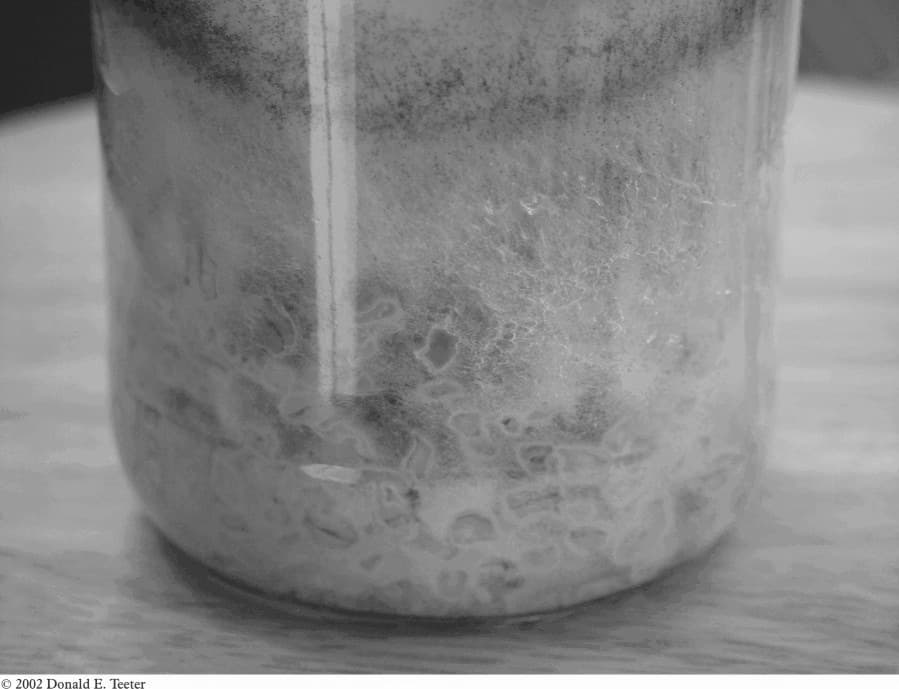
Amanita Muscaria growing on cooked Barley.
Making the Sacramental Wine
The Gospel of John 15: 1 1.
I am the true vine and my father is the husbandman.
The purpose of this is to instruct you in culturing your own alcohol free, sulfide free, Ambrosia Wine simply and cheaply at home using concentrated fruit juices, some simple equipment and the Ambrosia plant (Amanita Muscaria).
Amanita muscaria is immortal, all the culture techniques used by the ancients and by us today are based on the fact, that Amanita muscaria mushrooms can be dried, stored dry for a long time and when re-hydrated with water magically returns to life in three days as mycelium.
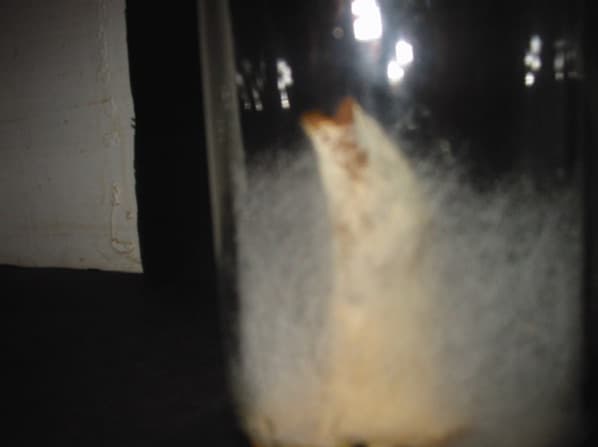
A single stem of dried Amanita muscaria on the third day after being re-hydrated with water and now growing mycelium, this is what the Amanita muscaria mycelium should look like.
In Soma: Divine Mushroom of Immortality, Wasson cites reports of Siberian Tribes who fermented Amanita Muscaria with various berry or fruit juices, diluted honey or with juice from a certain type of sweet grass. Many Tribes used these fermented juices for curing upset stomachs and other medicinal applications along with its use as an intoxicant.
The wines of the ancient Greeks and Romans were also capable of being used medicinally; Homer in the Iliad, states that undiluted Wine was used on battle wounds, (like an antiseptic) something that modern wine is never used for.
Unlike modern alcoholic wine, the Ancient wines of western Eurasia had to be diluted with a large quantity of water before being consumed; in fact, ancient sources state that consuming a large quantity of undiluted ancient wine could cause death. This wine was diluted with large ratios of water; ranging from one part wine with two to fifty parts water added.
These potent wines are mentioned in ancient literature such as Homer’s Iliad (800 BC) and were produced from very ancient times into the late Roman Era (500AD). At this time, the production seems to cease, along with any more mention of these very special wines in the literature of the day.
To give the reader a quick background on culture techniques that we will use here, we will look at the beginning of scientific microbial culturing. This uses glass bottles, a simple micro pore filter, and sterilization by the use of heat. Using these simple scientific techniques developed over the last one hundred years the average reader can easily culture the Ambrosia wine. There are significant benefits to this modern approach over the ancient methods, such as using just the tiniest amount of dried mushroom to start a culture and the high productivity with a very low contamination rate.
Louis Pasteur (1822-1895) is credited; with the important discovery that the air is full of microorganisms and their spores, which cause the spoilage of food and can cause diseases of plants, animals and man. He used a very simple experiment to prove his theory and this experimental technique is the basis of modern pure culture techniques for growing fungi, bacteria, yeasts, even plant, and animal cells in a sterile environment as a pure culture.
In Pasteur’s experiments, glass bottles partially filled with beef broth; milk or other foods that quickly spoiled in the open air were prepared. The bottles mouth was then plugged with a tight wad of waterproof cotton, the bottles were placed upright into a hot water bath and cooked to a temperature that killed all microbes inside the bottle, the hot air and steam generated in the bottle passing through the cotton wad. By cooking the bottles properly, the contents would not spoil, even if kept for months. The cotton plug did not seal out air so this was fundamentally different from canning which requires an airtight seal.
Pasteur further showed that if you removed the cotton plug from a sterile bottle exposing the sterile food contents to the microbe and spore filled outside air for even a few seconds, then reinserted the cotton plug, the contents always spoiled in a short time. Microscopic examination of the contents of the spoiled bottles always showed microorganisms, which were absent from the contents of the still sterile bottles.
Pasteur’s secret to creating a sterile environment with food and oxygen inside of the bottle is the cotton plug, which is sterilized during the cooking process by out flowing steam and hot air. The now sterile cotton plug becomes a micro-pore filter capable of filtering out all the microorganisms and their spores from the outside air that re-enters the bottle on cooling.
It should be obvious that if the right foods for a certain microorganism were prepared this way and then inoculated with even a small amount of that microorganism culture, that culture would flourish in this artificial environment without any competition from other microorganisms. If the inoculating culture is completely free of other contaminating microorganisms it will grow into a pure culture in the bottles. The cotton plug allowed oxygen-using cultures such as Fungi, to obtain oxygen from the outside air without allowing contaminating microbes into the pure culture.
Making the Sacred Ambrosial Wine is a simple process that requires only some easily obtained supplies and some commonly available equipment.
1 Dried Amanita Muscaria mushroom caps, you need low temperature dried Amanita Muscaria mushroom caps that will be used as the inoculant. If you purchase dried Amanita muscaria mushrooms, the higher grades are usually worth the extra money. If you picked and low temperature dried (120 degrees F or less) your own Amanita muscaria mushrooms, the caps of the best specimens should be saved separately for use as inoculant. These dried caps should be inspected carefully for dirt, pine needles etc, which should be removed, before they are ground into a fine powder. The small coffee grinders work very well and are inexpensive enough that one can be dedicated to only grinding Amanita muscaria. The inoculant should be ground fine enough (like flour), that it to floats on the surface of the juice.
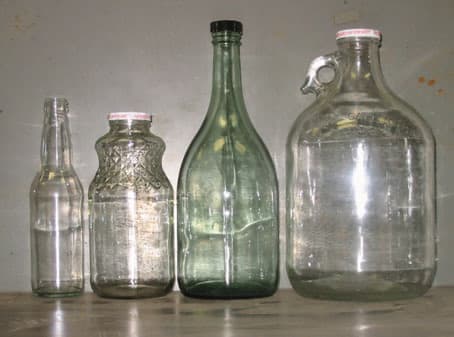
2 Glass bottles or jugs. Next, you need glass bottles of from 1 pint to 1-gallon capacity such as juice bottles of all sizes, beer bottles, wine bottles etc. however, bottles with a tapered neck are better than bottles with a short neck for plugging with the polyfill. The size of the bottles you can use, is determined by the size of the cooking pot you have. Clear glass bottles are preferable to brown, green or blue bottles to culture in since you can easily see the culture inside. I prefer; the clear glass 1-gallon jugs, they can hold up to three quarts of juice for culturing, they are the largest size bottle that is commonly found and yet they are small enough to easily handle when hot. New bottles need to be cleaned before using, with detergent and hot water and rinsed repeatedly to remove all traces of the detergent. Recycled juice and especially beer and wine bottles should be filled with a hot bleach solution of 1 fluid ounce of bleach for 1 quart of water, filled all the way to the top, sealed with the proper cap and left for several days, rinse the bleached bottles well before using. Always inspect the bottles carefully for cracks and chips which can cause breakage of the bottle during the heating and cooling cycle of pasteurization.
3 Polyfill, Mr. L Pasteur used specially prepared waterproof cotton, which would not absorb the water or steam generated by the cooking process to plug the bottles and create a micro-pore filter. Today waterproof cotton is very expensive, the last time I priced some from a science supply store it was over $35.00 a pound.
There is however, a superior substitute called Polyfill, which is a polyester fiber that resembles loose cotton, available from craft and fabric stores as a pillow stuffing. The polyester fiber is waterproof, not biodegradable, and is easily sterilized with the heat of pasteurization. A few dollars will buy you a big bag of Polyfill, which will last through a lot of culturing.
To use as a micro-pore filter, a polyfill wad is rolled into a ball about 3 or 4 times the size of the bottles mouth and pushed in with a twisting motion. The plug must be tight fitting and as the ball of polyfill is twisted into the bottle, the plug should get longer. It is a good idea to practice plugging an empty dry bottle of the kind you are going to use, to get the right feel before you actually start culturing.
4 Cooking pots, you, will need two cooking pots, a small stainless steel cooking pot of about 11/2 gallon to react the finished wine and a large one for pasteurization.
To pasteurize the juice in the bottles you need a hot water canner with a basket or a suitable sized cooking pot and a holed metal plate or stand to hold the bottles off the bottom of the cooking pot, I use the metal stand that came with a pressure cooker. The cooking pot must be large enough diameter to hold the bottles and deep enough to match or cover the juice level inside the bottle. Ideally, the pot should be deep enough to cover with a lid that does not touch the polyfill of the plugged bottles inside. You can use an aluminum pot to pasteurize the juice filled bottles, but never let grape juice or the wine touch an aluminum pot, utensil or foil. Acid containing liquids like grape juice will quickly dissolve aluminum into solution and create a poisonous product. Always use stainless steel or the new tempered glass cooking pots to react the finished wine.
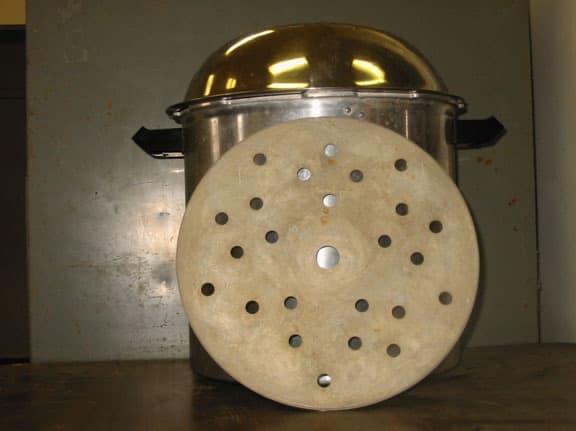
This is the Authors pasteurization equipment, a large pressure cooker pot, with the metal stand to hold the bottles off the hot bottom of the pot. There is no need to use pressure I simply use a stainless steel salad bowl for a cover that is tall enough to not touch the bottle’s polyfill plug.
5 An accurate waterproof thermometer that is easy to read in the temperature range of 150- 195 degrees F made of glass or stainless steel, I prefer Stainless steel, as it is unbreakable. You will probably have to rig a wire to hold the thermometer at the proper depth in the water.
6 A growing area, you need an area set aside to place the bottles during the time they are growing. The temperature needs to be from 64 to 74 degrees Fahrenheit and stable without fast or wide swings in temperature. A cabinet or closet will work, as well as an old refrigerator that has the doors shimmed open a small amount. The growing area should be easy to clean and thoroughly cleaned before being used the first time.
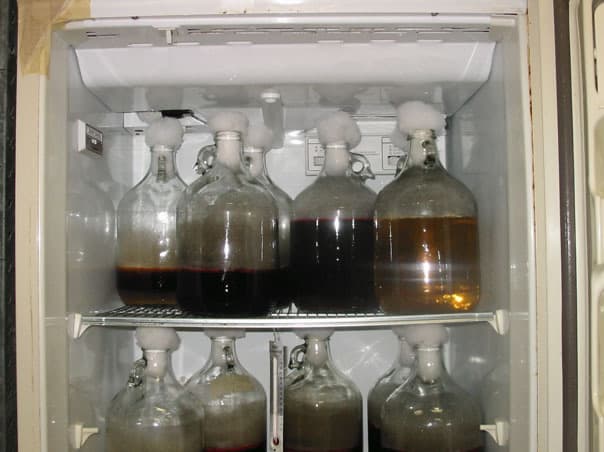
This is the Authors growing area, in an old refrigerator with the doors shimmed open slightly to provide for air circulation.
7 Fruit juice, you can purchase grape or other fruit juice in the frozen concentrate form, at any grocery store. For best results, this juice must be pasteurized, before being used to culture the Ambrosia wine. I prefer the frozen concentrate for several reasons, one, it’s much cheaper than bottled juice, two, by pasteurizing the juice in the polyfill plugged bottle that is going to be the growth chamber, a more sterile situation is created than simply pouring bottled juice into a clean bottle. Mix the thawed frozen concentrate juice with water according to the directions on the juice container. If you are using small bottles, mix the juice in a pitcher or a large bottle and pour into the small bottles.
Take the cleaned bottles or jugs you have chosen and fill to the start of the jugs shoulder or approximately ¾ full i.e. a quart bottle will hold 3 cups of juice and 1 gallon will hold 3 quarts. It is important to leave a suitable air space in the bottle and the largest surface area possible on the top of the juice to support the Amanita Muscaria fungus; which grows on the surface of the juice.
Carefully wipe the inside of the filled bottles mouth and neck with a clean piece of paper towel to remove any juice that might contact the polyfill plug. Juice left on the bottle’s neck or mouth may become a source of contamination and it gets sticky enough after pasteurization to pull fibers out of the polyfill plug when it is removed for inoculation. Now, plug each of the filled bottles with a tight fitting wad of polyfill.
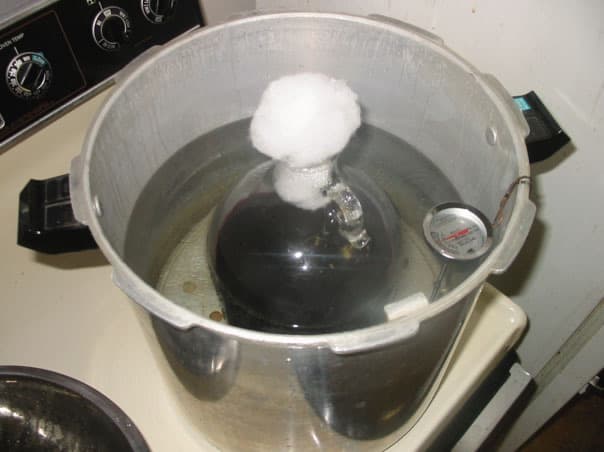
A polyfill plugged 1 gallon bottle containing 3 quarts of grape juice ready to be pasteurized.
Place the polyfill plugged bottles containing the juice into your cooking pot on a metal stand or in the canning basket, and add cool water to the pot until the water in the pot is just about 1 inch above the level of the juice in the bottles. Place the pot on a stove and slowly heat the water at medium or medium high until the water in the pot reaches 175 deg F (use a thermometer) turn heat down and hold at 175-185 deg F for 30 minutes.
Carefully remove the hot bottles from the water bath and place on a folded towel or a thick layer of newspaper to prevent the bottom of the bottles from breaking due to thermal shock. If you are going to pasteurize more bottles pour out the hot water from the pot and replace it with cool water as placing cool bottles into hot water can also cause breakage from thermal shock.
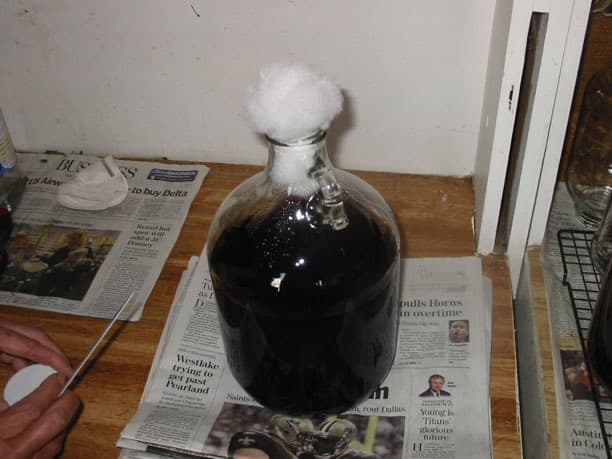
Cooled to room temperature the bottle is ready to inoculate
.
Once the pasteurized bottles have cooled to room temperature, they are ready to inoculate; this step must be preformed quickly to avoid contamination of the pasteurized juice, the whole operation of inoculation should take less than ½ second per bottle. Remove the polyfill plug straight up and hold about one inch over the mouth of the bottle and inoculate the bottle with approximately ½ an aspirin tablet size of the powdered inoculant for a gallon jug or ¼ that amount for a quart bottle. The point of a knife works well to pick up and handle the small amount of inoculant needed. The inoculant should be dropped onto the surface of the juice, quickly replace the polyfill plug into the mouth of bottle. Carefully place the bottles into their growing area without sloshing the fluid inside.
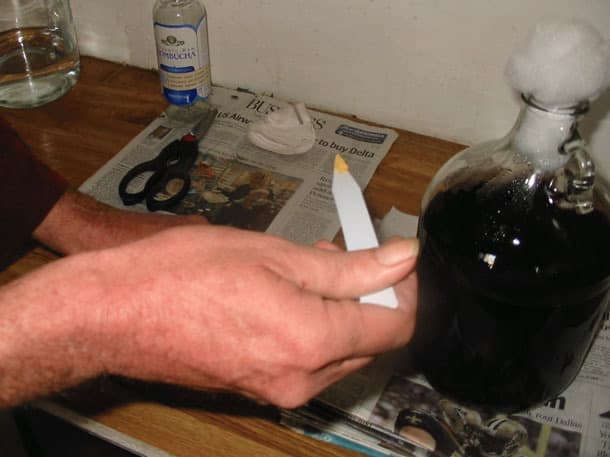
Inoculating the Grape juice with powdered Amanita muscaria
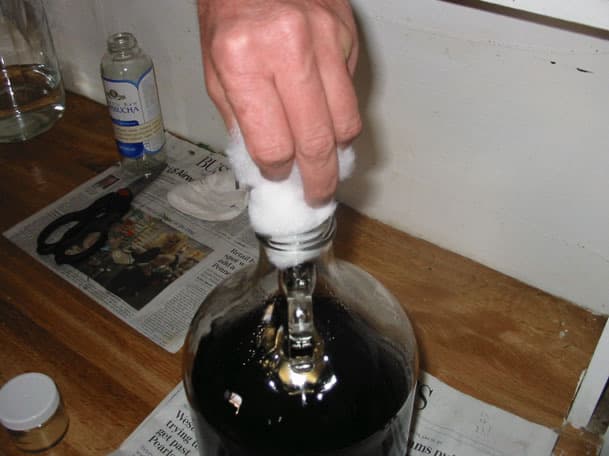
The juice is now inoculated with ground Amanita muscaria caps and the polyfill plug is being replaced
.
In 1½ to 3 days, the Amanita Muscaria mycelium should start growing large enough to see with the naked eye and in a few more days will become a thick mat of long white mycelium floating on the surface of the juice with fine filaments reaching into the juice.
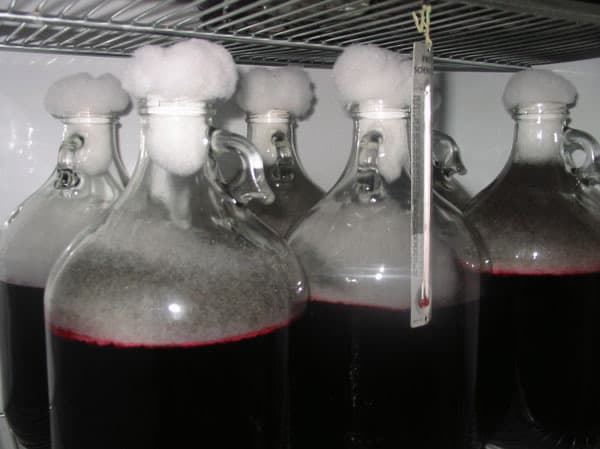
The long white to dark gray Amanita muscaria mycelium growing on pasteurized grape juice, converting the juice into the Sacred Ambrosial Wine.
In 3 to 4 weeks for the quart, sized bottles or 1 to 2 months for the gallon sized bottles depending on temperature and the amount of sugar in the juice the Wine should be ready. Young Amanita muscaria mycelium is white, as the culture ages the mycelium will start to turn gray and finally a very dark gray that almost looks black. This color change seems to be related to the amount of sugar in the juice. If you want a sweeter fruitier tasting wine harvest the wine when the mycelium turns uniformly light gray. When the mycelium is dark gray most of the sugar has been consumed and the Amanita muscaria mycelium will start eating the fruit flavor right out of the juice. It takes some time to develop a feel for when to harvest the wine to get the quality you want. Beginners can use a simple rule; to allow one week for starting and then add one week for every inch of the juice depth inside the bottle. Starting with an equal amount of juice, a narrow tall bottle will always take longer than a wide bottle filled a few inches deep.
When you think the Wine is ready pour off the juice through a funnel plugged with a small amount of clean Polyfill sitting in another bottle of suitable capacity. If the Amanita Muscaria fungus consumed all the sugars and other food in the juice, the raw wine will keep in a bottle at room temperature for a long time without going bad, being similar to vinegar, as ibotenic acid is chemically a form of acetic acid.
The Wine has two phases the raw and the reacted. The raw wine as poured from the fungus culture contains mostly Ibotenic acid and has an acidic taste. Consuming the raw Wine in any large quantity causes stomach upset for most people and it is not as potent as the same wine after it is reacted. Small quantities of raw undiluted Wine (1-4 oz) can be consumed medicinally for stomachaches, fevers, colds, or flues and can also be used as an antiseptic on wounds, but it stings like alcohol.
To react the raw Wine, the ibotenic acid is converted into muscimol; by heating in an open stainless steel pan or better yet, a stainless steel double boiler to more than 195 degrees F stirring constantly. This process drives off the CO2 molecule that is chemically bound to the ibotenic acid molecule, converting it to muscimol and creates a sweeter tasting wine that is 4 to 10 times stronger in potency than the acidic form. The released CO2 forms very small bubbles, which can easily be seen in the wine when it is heated to the correct temperature. Once the wine starts to simmer and release steam, at temperatures above 195 degrees F, most of the CO2 is gone and the reaction is now done. From sea level to 3000 feet this temperature recommendation holds true, at higher elevations, the upper temperature needed to release the CO2 molecule will be lower.
The reacted Wine should be diluted with water, in the ancient ratios of 2-20 parts water for every part Wine before drinking. The properly diluted Wine is more pleasant to drink and more potent than the undiluted Wine.
An alternate method of reacting and diluting the raw wine in one operation is to fill a stainless steel cooking pot with three or four times the volume of good drinking water for every volume of raw wine. Cover the pot and heat this water to a rolling boil then pour in the raw wine and stir, continue to heat at a lower setting, stirring regularly, until the temperature reaches more than 195 degrees Fahrenheit. Shut off the heat, cover and if it is going to be used that day let it sit until cool.
If you wish to bottle this, reacted and diluted wine for later use; pour the still hot (180+ degrees F) wine into cleaned fruit juice bottles or jugs; filling all the way to the top of the bottle and then cap the bottle with the proper cap. On cooling, a vacuum is created inside the bottle and if the seal between bottle and cap is airtight, the cap should be depressed by the outside air. If the cap did not depress on cooling then an airtight seal was not formed and the wine in that bottle should be used immediately. Only store bottles whose caps were depressed, and if a stored bottle is later found to have a raised cap do not use the contents.
I only use recycled bottles, which have the screw caps, to store the finished wine, the screw cap being much simpler and less expensive than other ways of sealing a pasteurized bottle.
If you wish to use beer bottles to store the pasteurized reacted wine, you need a hand capper and caps available at homebrew beer supply stores.
Wine bottles that use corks can also be used to store this reacted and pasteurized wine and the equipment needed to cork the bottles is also available at homebrew and wine making supply stores. However natural corks have many problems including a specific bacterium found on about 1 in 5 corks that while harmless to humans, can ruin the taste of the stored product. Natural corks may not seal airtight and the cork and the bottles mouth must be dipped into melted sealing wax while the bottle is still hot, to insure an airtight seal.
Artificial plastic corks are available from the same homebrew and home wine supply stores. These plastic corks were developed specifically to overcome the shortcomings of natural corks and are preferable to the natural corks in every way but appearance.
To keep for long-term storage the bottled wine should be stored in a cool dark area to prevent light damage to the wine, which can change the flavor and color. Dark green or brown bottles are more resistant to light and help preserve the flavor better than clear glass bottles.
To serve the bottled diluted reacted wine simply open the bottle and serve at room temperature or chill before serving. Raw wine must be reacted before serving, see the instructions above for details. Reacted undiluted wine must be diluted with water before serving, the ancient ratios of 3 or 4 parts water to one of wine is usually adequate for most Ambrosial wine.
The Ambrosial Wine stimulates the appetite and the taste buds, and it makes an excellent dinner wine. Food should always be served with this wine, even if it is just snacks like cheese and crackers.
I have used other juices to grow the Amanita muscaria culture on including white grape juice, apple juice, pineapple juice, and orange juice. These last three juices do not contain as much sugar as grape juice, and unless sugar is added during mixing, they are not as strong as the grape wine. Blueberries are related to bilberries, which have been recorded as being used in Siberia to culture Amanita muscaria, but I have not found a good source of blueberry juice yet. I think any fruit juice that is both sweet and acidic could be used to culture Amanita muscaria on.
If you have a very clean area to work in you can pull small clumps of mycelium from your wine cultures that are being harvested, with a piece of wire bent into a hook, flame the wire before using. These clumps of mycelium can then be used to inoculate freshly pasturized juice to start the cycle over again.
The ancient Christians served their version of the Sacramental Wine when they celebrated the Agape, or “love feast”, and the Communion. The Eucharist Wine and the Living bread are the foundation stones of the earliest Christians beliefs. With these Sacraments made from the “Bread from Heaven”, they healed the sick, uttered prophecies, spoke in tongues, and were themselves spiritually reborn by consuming the “Flesh and Blood of God”.